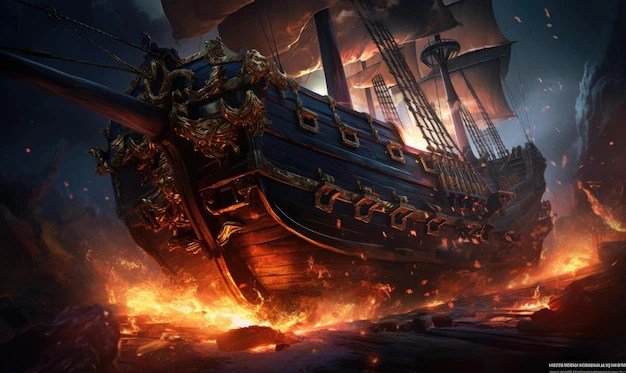
Forget the Hollywood glamour of eye-patches and talking parrots; the true "Piratenkultur, Legenden & Seemannssprache" of the high seas spins a far more complex and captivating yarn. While blockbuster movies like "Pirates of the Caribbean" or manga sagas like "One Piece" paint a picture of swashbuckling freedom, the reality of pirate life was a brutal dance with danger, starvation, and the constant threat of a hangman's noose. Yet, it's precisely this perilous allure that has cemented pirates as enduring figures in our collective imagination.
This isn't just a nostalgic dive into old tales. Understanding pirate culture, the true stories behind the legends, and the rich nautical lexicon not only deepens our appreciation for maritime history but also offers unique insights into human ambition, rebellion, and survival. It's a journey into a world where freedom was forged in desperation and language became a lifeline.
At a Glance: What You'll Discover
- Beyond the Myth: The stark reality of pirate life compared to romanticized portrayals.
- Legendary Figures: Uncover the true histories of notorious pirates like Blackbeard, Anne Bonny, Klaus Störtebeker, and Ching Shih.
- The Language of the Waves: Explore essential German nautical terms and how they unlock cultural and historical insights.
- Cultural Echoes: Understand how pirate legends reflect historical contexts, folklore, and societal values.
- Interactive Learning: Practical ways to engage with pirate stories for a richer understanding and even language learning.
- Debunking Myths: Separate fact from fiction in common pirate lore.
The Lure of the Jolly Roger: Romance Versus Reality
From childhood dreams of buried treasure to cinematic epics, the image of the pirate is steeped in an irresistible mystique. The promise of adventure, the thrill of the chase, and the freedom from societal constraints offer a powerful fantasy. Yet, peel back the layers of these alluring narratives, and you find a starker, grittier truth. Life aboard a pirate ship was a grueling existence, characterized by relentless toil, meager rations, and the ever-present specter of violent storms or swift justice.
The romanticized view often overshadows the immense physical strain of sailing, the constant risk of disease, and the dire consequences if captured—typically, a swift and public execution. Despite these grim realities, the dangerous appeal of piracy continues to captivate, making these rogues of the sea fascinating subjects of historical and cultural study. They represent the ultimate rebellion, a refusal to conform, and a pursuit of fortune against all odds.
Icons of Infamy: The Most Legendary Pirates and Piratesses
The annals of maritime history are replete with figures whose names strike fear and fascination in equal measure. These individuals, whether ruthless buccaneers or strategic commanders, carved out their legacies in an era defined by sail and sword. Let’s look at some of the most prominent.
Blackbeard (Edward Teach): The Terror of the Atlantic
Perhaps the most feared pirate of the Golden Age, Edward Teach, or "Blackbeard," cultivated an image of sheer ruthlessness. His legend was amplified by Captain Charles Johnson's influential book, "A General History of the Robberies and Murders of the most notorious Pyrates," which cemented his reputation as a merciless brute. Teach reportedly braided fuses into his beard, lighting them before battle to appear as a demonic figure emerging from smoke, striking terror into the hearts of his enemies.
Despite his fearsome reputation, Blackbeard's actual career as a pirate was remarkably short, lasting only about 15 months. It concluded in a bloody confrontation with the Royal Navy in 1718, where he met his end after sustaining five pistol shots and twenty sword cuts. Whether "Edward Teach" was his birth name remains a mystery, adding another layer to the enigma of this legendary figure.
Anne Bonny and Mary Read: Breaking the Mold
Among the predominantly male world of piracy, Anne Bonny and Mary Read stand out as defiant "Pirate Queens." These remarkable women sailed under the infamous Jack Rackham (Calico Jack) until 1720. Both initially joined the crew disguised as men, a common strategy for women seeking opportunities denied to them by societal norms. However, their true identities eventually became known to the crew, and they shed their disguises.
Their story took a dramatic turn when they were captured alongside Rackham and his crew. Facing the gallows, both women famously "pleaded the belly," claiming pregnancy to stave off execution. While Mary Read is believed to have died in prison, Anne Bonny's ultimate fate remains unknown, fueling further speculation and cementing their status as icons who boldly challenged established gender roles and carved out their own destiny on the high seas.
Klaus Störtebeker: Germany's Rebel of the Seas
A name synonymous with German pirate legends is Klaus Störtebeker. His fame endures, particularly through the annual "Störtebeker Festspiele" on the island of Rügen, which draws thousands to witness his dramatized exploits. Störtebeker was part of the "Vitalienbrüder" (Victual Brothers), a group of privateers who, driven by necessity and opportunity, evolved into pirates operating in the North and Baltic Seas during the late 14th century.
Born around 1360, Störtebeker was likely from Mecklenburg. Many myths surround him, the most famous being the tale that after his capture and condemnation, he negotiated with his captors: he would run past his men after being beheaded, and every man he passed would be granted freedom. Legend says he passed eleven men before a guard tripped him. This fantastical story, while unsubstantiated, highlights the deep cultural resonance and enduring appeal of Störtebeker's defiance and his connection to the common people.
Ching Shih (Zheng Shi, Madame Ching): The Unconquerable Admiral
Hailing from China, Ching Shih is arguably the most successful pirate in history, transcending the notoriety of her Western counterparts. Her journey began as a prostitute before she married a powerful pirate, taking command of his vast fleet after his death. Under her leadership, the fleet grew to an astonishing 2,000 ships and commanded between 60,000 to 80,000 pirates. By her late twenties, she was already leading this formidable force.
What truly sets Ching Shih apart is her unparalleled success: she was never defeated by the Chinese Navy. Instead, she commanded such respect that the Chinese government eventually negotiated her retirement, granting her amnesty for her crimes. She lived to a ripe old age, dying peacefully in 1844, a testament to her extraordinary strategic prowess and leadership. Her story is a powerful reminder that the narrative of piracy is global and diverse, extending far beyond the Caribbean.
Bartholomew Roberts ("Black Bart"): The Golden Age's Grand Finale
Bartholomew Roberts, known as "Black Bart," marked a poignant end to what historians often call the "Golden Age of Piracy." His death on February 10, 1722, signaled the beginning of the decline of this era. Roberts was an astonishingly prolific pirate, capturing over 400 ships during his relatively short career. He was unique among pirates for his lavish taste and his command of a formidable vessel, the "Royal Fortune," which boasted over 40 cannons—an unusual show of force for a pirate ship.
Roberts was also renowned for his eccentric pirate flags, which often depicted himself standing on two skulls, symbolizing "A Barbadian's Head" and "A Martinican's Head," in defiance of the islands that had wronged him. His flamboyant style and remarkable success solidified his legend as one of the most daring and effective pirates of his time, closing out an era with a bang.
Other Noteworthy Figures
While these five stand out, the seas were home to countless other figures whose stories continue to intrigue:
- Captain Kidd: Known for persistent rumors of vast, buried treasures, which have fueled treasure hunts for centuries.
- Sir Henry Morgan: A Welsh privateer who terrorized Spanish colonies, eventually becoming a knight and Lieutenant Governor of Jamaica, and lending his name to the famous rum brand, Captain Morgan.
- Henry Every ("Long Ben"): Famous for orchestrating one of the most profitable pirate raids in history, disappearing without a trace after capturing two pilgrim ships laden with treasure.
- Fanny Campbell: A lesser-known but equally fascinating figure whose daring adventures were chronicled in a popular book, adding to the rich tapestry of pirate lore.
Speaking the Language of the High Seas: Nautical Lexicon (Seemannssprache)
Beyond the historical figures and dramatic tales, there's a practical and profound layer to "Piratenkultur": the language itself. The specialized vocabulary of sailors and pirates, or "Seemannssprache," is not merely jargon; it's a testament to centuries of maritime life, encapsulating the challenges, tools, and dangers of the ocean. For anyone fascinated by the sea, or even those looking to broaden their linguistic horizons, this lexicon offers a unique window into a bygone era.
Why Nautical Terms Matter
Understanding nautical terminology allows you to truly immerse yourself in maritime narratives. It's the difference between reading about a "boat" and visualizing a "galleon," or knowing the precise actions of "hoisting the colors" versus simply "putting up a flag." These terms provide precision, historical context, and a vividness that enriches any discussion of the sea.
Essential German Maritime Vocabulary
Learning German nautical terms can be a highly engaging way to enhance your vocabulary, particularly through the context of exciting pirate stories. Here are some fundamental terms:
- Schiff (ship): The most basic term, but essential for any maritime discussion.
- Segel (sail): The driving force of classic sailing vessels.
- Anker (anchor): Crucial for securing a ship in port or at sea.
- Kapitän (captain): The commander of the ship, the ultimate authority.
- Mannschaft (crew): The collective body of sailors operating the vessel.
- Kompass (compass): The indispensable navigational tool.
These terms form the bedrock of understanding any German-language pirate story or historical account. They aren't just words; they're keys to unlocking deeper immersion.
Action & Adventure: Verbs and Adjectives
Pirate stories are inherently dynamic, full of conflict and daring deeds. The vocabulary used to describe these actions brings the tales to life:
- Angreifen (to attack): Essential for describing naval battles and raids.
- Verteidigen (to defend): The counterpoint to attacking, often involving desperate struggles.
- Erobern (to conquer): To seize a ship or territory, a primary pirate objective.
- Fliehen (to flee): The act of escape, often under duress.
- Mutig (brave): A quintessential pirate trait, whether real or imagined.
- Gefährlich (dangerous): Describes the inherent nature of pirate life and the sea.
Incorporating these dynamic verbs and adjectives not only expands your linguistic range but also allows for more vivid storytelling and engaging conversations, even outside of maritime contexts.
Historical Context in Words: The "Vitalienbrüder"
Sometimes, a single term can unlock a wealth of historical information. "Vitalienbrüder" (Victual Brothers) is one such example. This term, referring to medieval privateers who turned to piracy, immediately evokes a specific period and geopolitical context—the struggles between the Hanseatic League and its adversaries. Breaking down the term helps: "Victuals" refers to provisions or food, indicating their original role in supplying besieged cities. Their evolution into "brothers" (i.e., a brotherhood) who engaged in piracy against specific targets, and later anyone, reflects the shifting moral landscape of the time. Understanding such terms deepens your grasp of historical narratives and the underlying cultural values they represent.
The Fabric of Pirate Culture: Legends, Lore, and Lifelong Learning (Piratenkultur & Legenden)
Pirate stories do more than entertain; they offer a rich tapestry for exploring history, culture, and the human condition. They serve as a powerful tool, particularly for those looking to connect with German history and folklore in a meaningful way.
From Swashbuckling Tales to Historical Truths
The legends associated with pirates, like those of Klaus Störtebeker and the Hanseatic League, are intrinsically linked to specific historical periods and geographical regions. These stories are not just isolated narratives but reflections of broader historical contexts, shedding light on medieval trade, power struggles, and the emergence of early forms of organized crime at sea. By delving into these legends, you gain a tangible connection to Germany's past, understanding how these tales shaped popular imagination and continue to influence modern culture.
Grammar Goldmines in Pirate Dialogues
For language learners, pirate dialogues are a treasure trove of practical grammar lessons. The direct, often urgent nature of commands and proclamations on a ship provides clear examples of grammatical structures:
- Direct Speech: Observing how characters communicate offers clear insights into sentence construction and punctuation. For instance, notice the difference in English: "We must find the treasure!" shouted the captain. versus the German: “Wir müssen den Schatz finden!” rief der Kapitän.
- Imperative Mood: Pirate conversations are packed with commands, making them excellent practice for understanding and using the imperative. Think of classic orders like the English: "Raise the sails!" directly translating to the German: “Setzt die Segel!” These simple, direct commands are easy to grasp and immediately applicable.
Analyzing these elements in context makes learning grammar less abstract and more engaging, showing how language functions in vivid, real-world (or at least story-world) scenarios.
Cultural Echoes: "Seemannsgarn" and Storytelling
Beyond grammar and vocabulary, pirate stories offer a window into cultural nuances. The term "Seemannsgarn" (literally "sailor's yarn") perfectly encapsulates the tradition of exaggerated stories spun by sailors, often tall tales or embellished accounts of their adventures. This concept reflects the cultural significance of storytelling, not just as entertainment but as a way to cope with hardship, build camaraderie, and pass down experiences—even if slightly embellished—through generations. Understanding "Seemannsgarn" means appreciating the role of oral tradition and the human need for narrative in maritime communities.
Engaging with Pirate Lore: Interactive Learning Journeys
The appeal of pirates is universal, making their stories an excellent foundation for interactive and immersive learning experiences. Whether you're a history enthusiast, a language learner, or simply someone looking for a fun new hobby, pirate lore offers rich avenues for engagement.
Role-Playing for Fluency
One of the most effective ways to internalize vocabulary and grammar, especially for language learners, is through role-playing. Imagine scenarios on a pirate ship:
- Giving commands to your imaginary crew.
- Planning a daring raid.
- Negotiating with a captured merchant.
By creating and acting out these scenes in German, for example, you can practice speaking and listening in a dynamic, low-stakes environment. This active engagement makes the language feel alive and directly applicable, boosting both confidence and comprehension.
Crafting Your Own Sea Saga
What if you were a pirate? What would be your name? What kind of adventures would you have? Writing your own pirate legends in German allows you to apply all the vocabulary and grammar you've learned in a creative context. This exercise not only reinforces linguistic skills but also encourages imaginative thinking and storytelling. You might even find inspiration for your own unique pirate identity—and if you're looking for the perfect alias, you can always Generate your perfect pirate name to kickstart your creative journey.
Immersive Listening Adventures
For those who prefer auditory learning, seeking out German audio versions of pirate legends, documentaries, or even movies can be incredibly beneficial.
- Transcribe sections: Challenge yourself to write down what you hear to sharpen your listening skills.
- Summarize stories: Listen to a tale and then try to summarize it in German, practicing both comprehension and verbal recall.
These activities enhance your understanding of spoken German, expose you to different accents and speech patterns, and further immerse you in the world of pirates.
Unearthing Hidden Treasures: Debunking Pirate Myths
While the allure of pirate legends is undeniable, many popular notions about these sea rogues are more fiction than fact. Separating the "Seemannsgarn" from historical reality helps paint a clearer, more nuanced picture.
Myth: All pirates buried treasure.
Reality: While some pirates, like Captain Kidd, are associated with buried treasure, it was an incredibly rare practice. Pirates typically spent their spoils quickly on drink, gambling, and women. Carrying large amounts of treasure on land was risky, and it was far more practical to distribute and spend it. Most pirate "treasure" consisted of perishable goods, fabrics, and trade items, not chest-loads of gold and jewels.
Myth: Pirates made people "walk the plank."
Reality: The image of a victim forced to walk a plank off the side of a ship is a dramatic staple of pirate fiction, but there's almost no historical evidence to support it. Pirates were brutal, but their methods of torture or execution were usually more direct, such as marooning, flogging, or outright murder. The plank walking trope likely gained traction in 19th-century adventure novels.
Myth: Pirates said "Arrr!" and had parrots on their shoulders.
Reality: The stereotypical pirate accent and the ubiquitous parrot are largely inventions of popular culture, notably Robert Louis Stevenson's "Treasure Island." While some pirates may have adopted colorful speech, there was no universal "pirate accent." Parrots were exotic pets traded in port cities, and some sailors might have owned them, but they weren't a common fixture on pirate ships.
Myth: All pirates were freedom-loving rebels fighting oppression.
Reality: While some individuals might have been driven to piracy by harsh conditions or social injustice, many were simply opportunistic criminals driven by greed. Life on a pirate ship was often authoritarian, with strict rules and harsh punishments, albeit sometimes with a more democratic distribution of plunder and decision-making than naval vessels. Their primary goal was wealth and survival, not necessarily social reform.
Your Voyage Continues: Embracing the Legacy
The world of pirates, with its intricate "Piratenkultur, Legenden & Seemannssprache," remains a captivating realm. From the chilling real-life exploits of Blackbeard to the strategic genius of Ching Shih, and the local legends of Klaus Störtebeker, these figures continue to resonate because they embody universal themes: the allure of freedom, the pursuit of fortune, and the sheer audacity of challenging established norms.
By looking beyond the romanticized stereotypes and delving into the historical facts and linguistic nuances, we gain a much richer appreciation for this complex chapter of human history. Whether you're drawn to the strategic battles, the human stories of defiance, or the linguistic insights hidden in old sea yarns, the legacy of the high seas offers an endless bounty for exploration. So hoist the main sail, set your course, and keep discovering the enduring magic of the pirate world.